
Reform Will Collapse

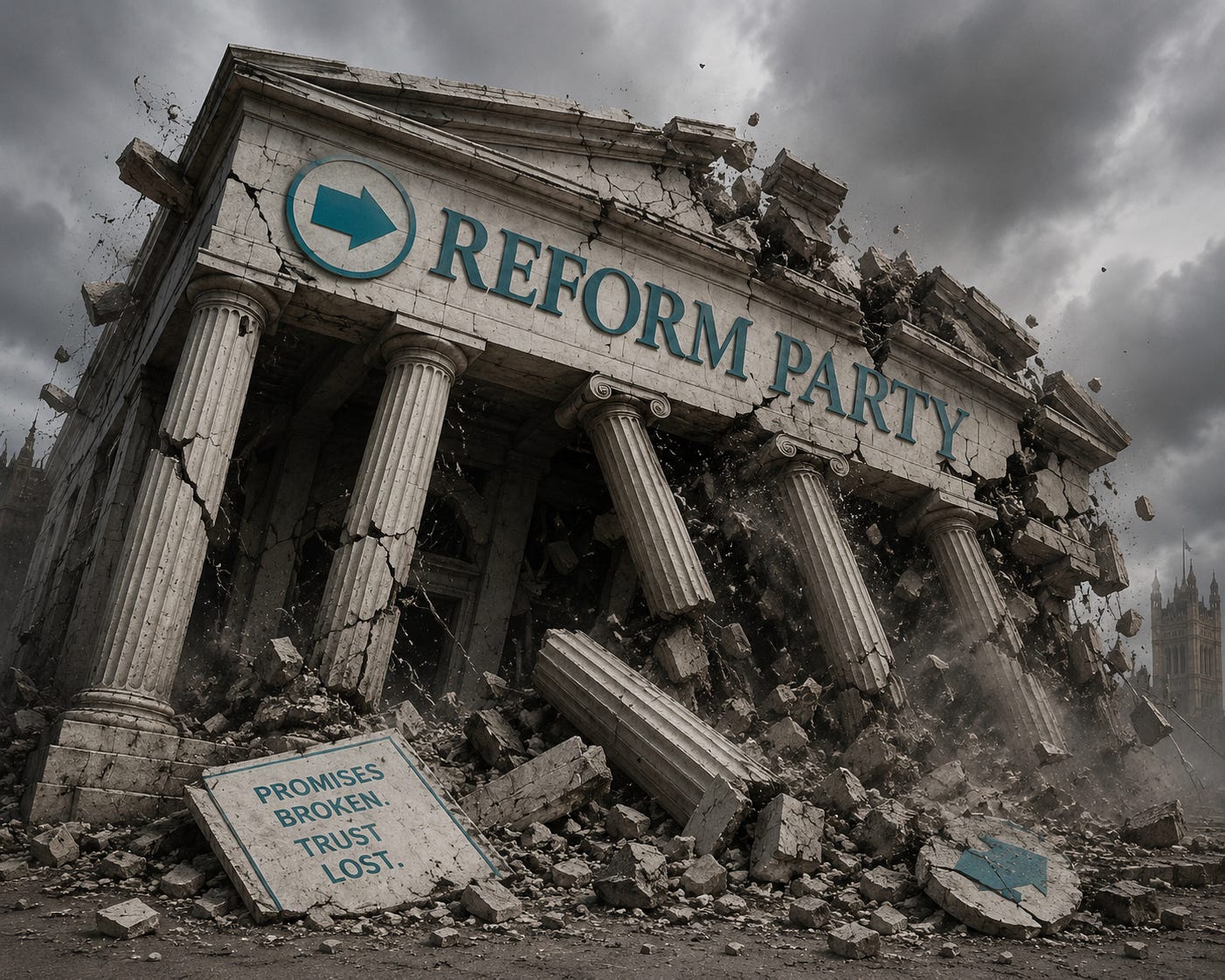
By Christmas, the party that promised to clean up British politics will be consumed by courtrooms, convictions and its own contradictions.
Reform will collapse.
Not because its voters will suddenly become happy with Westminster. Not because immigration will stop mattering. Not because Britain will rediscover its love for the Conservatives.
It will collapse because a political party cannot survive when too many of its senior figures are fighting criminal cases, appearing in court or serving prison sentences.
That is the premise of this forecast, not a claim that anyone currently under investigation is guilty. Allegations are not convictions, and due process matters. But if the legal and financial questions surrounding Reform continue to grow, the party may end 2026 as a collection of defendants, former allies and people insisting they barely knew one another.
A party cannot campaign from the dock
Reform was built around personalities, media attention and the claim that its leaders were different from the people they condemned. They were the outsiders. The truth-tellers. The people who would expose a corrupt system.
That message collapses the moment the party itself becomes associated with police inquiries, money trails, undeclared support, company structures and court dates.
Every interview changes.
The questions are no longer about migration, tax or the NHS. They become: who paid, who knew, who declared it, where did the money go, and why did nobody ask?
At that point, Reform loses control of its own story.
Candidates distance themselves from the leadership. Councillors resign or sit as independents. Former loyalists insist they raised concerns privately.
The movement that attacked Westminster for evasions becomes trapped in evasions of its own.
That contradiction will destroy it faster than any rival party could.
The voters will not disappear
Westminster will make one enormous mistake.
It will assume that the collapse of Reform means the collapse of the anger behind Reform. It will not.
Millions supported the party because they believed the political system had stopped listening. Some were angry about immigration. Others were angry about wages, housing, public services, cultural change or the sense that the country was being managed for somebody else.
Some wanted radical change. Others simply wanted to punish the establishment.
Those voters will not quietly return to the parties they abandoned. Many will feel betrayed by the people who promised to speak for them.
The party may be gone.
The grievance will remain.
The Conservatives will inherit a civil war
The Conservatives will expect to benefit first.
Kemi Badenoch will argue that Reform was always unserious and only the Conservatives can offer a credible government of the right. Some voters will return.
But her party spent years chasing Reform’s language and voters. It cannot suddenly pretend it stood apart.
The internal argument will begin immediately.
Moderates will say Reform’s collapse proves voters want competence, discipline and integrity.
The populist wing will say Reform’s ideas were right, but its organisation was weak and its leadership reckless.
One side will demand traditional conservatism. The other will demand Reform’s politics with better lawyers and cleaner paperwork.
The destruction of Reform may not end the civil war on the right.
It may simply transfer it into the Conservative Party.
A successor will emerge
Political anger does not sit still.
A replacement movement will appear quickly, built from former Reform MPs, online personalities, wealthy backers and activists who believe they deserve to inherit the cause.
It will promise the same insurgency without the baggage.
There will be a Union Jack, a dramatic launch video and a slogan about restoring or reclaiming Britain.
Then the arguments will begin.
One faction will want lower taxes and a smaller state. Another will want more spending on pensions, the NHS and struggling towns. Some will demand nationalisation. Others will preach aggressive free-market economics.
They will agree on immigration, that Westminster is broken, and that they personally should be on television more often.
Beyond that, unity will be difficult.
The successor to Reform could begin by reproducing the same contradictions that destroyed Reform.
Andy Burnham will claim the victory
Andy Burnham will present Reform’s collapse as evidence that Britain rejected division.
He will speak about hope, patriotism and bringing the country together. He will visit northern towns and argue that Labour defeated populism by finally listening.
He will also take credit for much of the delivery machinery built before he entered Downing Street.
Keir Starmer did the difficult work: creating structures, beginning programmes, negotiating agreements and accepting the political pain that comes before results become visible.
Andy will inherit that machine.
He will wrap it in warmer language, communicate it more effectively and present the output as proof of his own leadership.
Keir built it.
Andy will unveil it.
Then reality will arrive
The collapse of Reform would weaken Burnham’s opponents.
It would not fix Britain’s finances.
The government would still face weak growth, expensive debt, housing shortages and strained public services.
Burnham can promise lower bills, regional renewal and a repaired NHS.
Eventually, he must answer the oldest question in politics.
Who pays?
Does he raise taxes? Borrow more? Delay spending? Or abandon one of the promises that helped him reach Downing Street?
That will be the real test.
Burnham’s danger is believing Reform collapsed because Britain fell in love with him.
It will not have collapsed because of Andy.
It will have collapsed because Reform destroyed itself.
Britain at Christmas
By December 2026, Reform may still have a website, a bank account and a handful of councillors.
But it will no longer be a credible national force.
Its leading figures will be divided between courtrooms, prison cells, legal offices and television studios where they blame one another.
The Conservatives will be stronger but split over whether to reject Reform or absorb its politics.
A successor movement will be emerging, already fighting over leadership, money and ego.
The Greens will press Labour from the left. The Liberal Democrats will target individual seats.
Andy Burnham will dominate the stage and claim a new era has begun.
Britain may look calmer.
It will not be calm.
Immigration will remain explosive. Housing will remain unaffordable. Public services will remain under pressure. Trust in Westminster will remain dangerously weak.
Politicians must not mistake the death of a party for the resolution of the forces that created it.
You can prosecute offences where the evidence supports a prosecution.
You can imprison people after conviction.
You can close an office and remove a logo from the ballot paper.
You cannot imprison political anger.
Reform will collapse.
The real battle will be over who inherits the wreckage.